School of Chemistry & Physics

Areas of Study

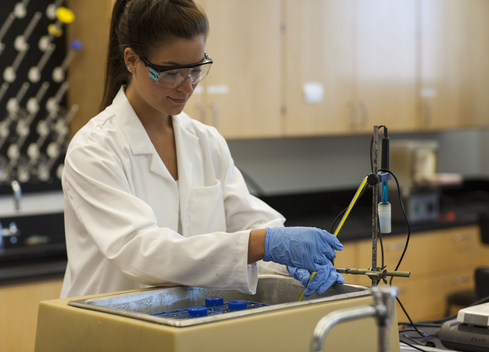
female chemistry student
  • One Field of Study, Many Career Options

    The Chemistry Major

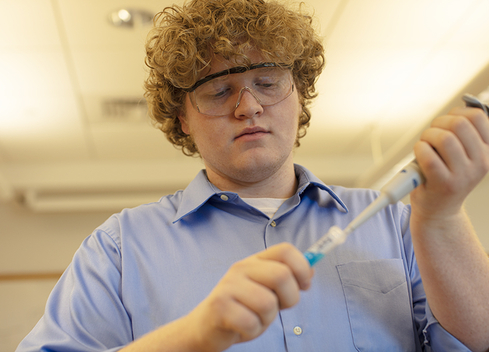
    Chemistry is an exciting diverse field. The discipline of working in chemistry gives you habits of mind that serve you well throughout your life. There is real value in tackling a hard task capably. That is what we offer you. Our major has a core requirement that includes one semester of undergraduate research. You may pursue a program leading to either a B.A. or B.S. degree. The major consists of 39 to 48 credits. The 39 hour sequence is often selected by double majors and pre-professional students. The longer sequence is strongly recommended for students contemplating a career as a professional chemist.

    The Physics Major

    Physics is a dynamic field that prepares students for careers in physics, engineering, and a variety of related fields. Our major has a core requirement that includes at least one full academic year of undergraduate research, to emphasize performance learning. The Physics major consists of a core of 41 credits, which includes 9 credit-hours of physics courses at the 300-level or above. Our curriculum prepares future physicists and engineers for success, as evidenced by the fact that, over the last 20 years, 100% of graduates from our Physics/Pre-Engineering programs have gone on to earn advanced degrees in physics, chemistry, or engineering or have entered the workforce in their chosen profession.

Undergraduate Programs

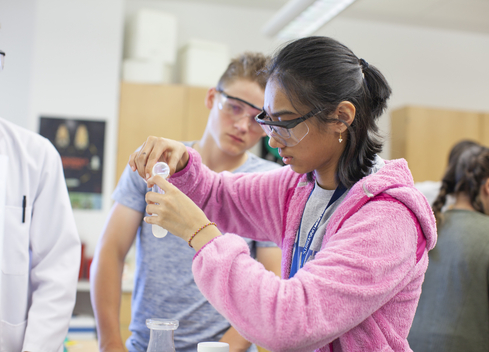
  • student measuring pouring fluid from a test tube

    Biochemistry

    The Department of Chemistry is committed to providing the very best education possible for students interested in pursuing careers in science related professions.
  • Student with lab equipment

    Chemistry

    Chemistry prepares students for diverse fields, including medicine, biotechnology, the food industry, chemical engineering, research, education, business, and more.
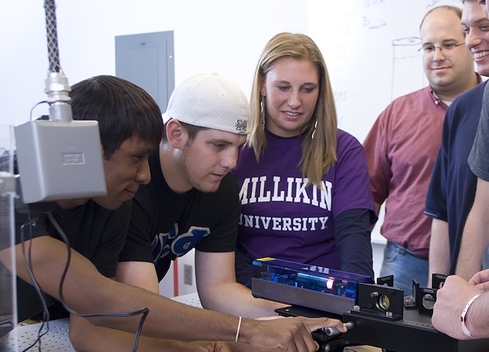
  • physics students

    Physics

    The study of physics prepares students to be physicists, engineers (aerospace, civil, mechanical, electrical, and nuclear), programmers, and much more. Our flexible curriculum gives you the freedom to choose the program of courses that best serves your post-graduation plans.

Minors

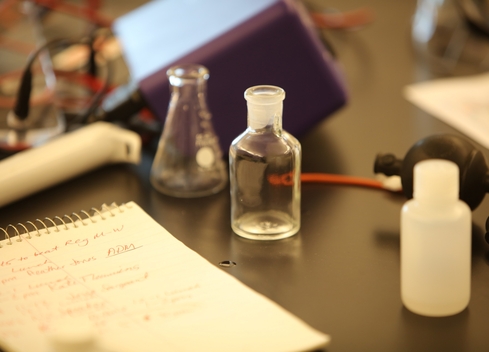
  • various lab equipment

    Chemistry Minor

    A minor in chemistry may be earned by completing a minimum of 21 credits in chemistry courses numbered 151 or higher, but excluding Chemistry 203 and 205, Essentials of Organic and Biochemistry, and CH314, Pharmacology, and including at least nine credits in courses numbered 300 or higher.
  • Physics

    Physics Minor

    There are many fields for which additional coursework in physics is useful, but not as much as it would take to get a major.